Subscribe by RSS

Monday, 31 August 2026

Messages from beyond


It's been a week or two since I swept the floor in my utility room so imagine my surprise when I started to do so this morning and spotted this. It's an Allen key, an elastic band and a matchstick, but that's missing the point. It's clearly a message. 

From whom I wonder? Ants? Spirits? A burglar with a sense of humour? I have no idea. I do know it's unwise to ignore messages from other species, such as dolphins, so I'm taking this seriously.

But is it really a message or could it just be a chance arrangement of random items in an unswept utility room, in which our pattern-seeking brains find meaning where there is none?

Good question. It's often been said that a monkey tapping randomly on a typewriter could, given an infinite time, reproduce the entire works of Shakespeare. [Somebody actually tested this, by the way - I'm not making this up - and left a typewriter in the monkey cage at Paignton Zoo for six weeks. They didn't get Hamlet. The monkeys typed the letter S for while, got bored, stood up and pissed on the typewriter.]

Where was I? Oh yeah, random or message? See I don't think I've got ants and I know I don't have monkeys. Maybe spirits then? But I've lived in this house for 40 years and, athough not the most observant, I must have noticed something by now if the house were haunted.

Even without ants and monkeys, the human brain can find meaning - such as faces in clouds or fairy castles in a fire - where there is none. The scientific explanation points to the difference between incidence and coincidence. What's the chances of stuff on a floor arranging itself into the word Lol? Not high.

But what's the chances of stuff on a floor unswept for weeks arranging itself into something that seems to have meaning? Considerably higher. 

So we go with the science then and decide it's not a message? We..ell. I agree it's probably not, but should I pass up the chance of a friendly encounter with ants, mice or voices from beyond? I don't think I should.

So here's the plan. I've sent a message back and I'm quite hopeful that it could be the beginning of a beautiful friendship. I will keep you posted.


Saturday, 19 October 2024

My yellow sister

The puzzled expression on the craggy features of our Corsican wildlife expert tells me that 'I've lost my yellow sister', doesn't make any sense to him, and what's more - the exaggerated Gallic shrug and receding back pointedly add - I am confusing him with someone who gives a merde.

Which leaves me both embarrassed by my schoolboy French and still short one younger sister, who has either wandered off into the sweet-scented, shrubby undergrowth, through which our coastal path is meandering, or plunged off the cliffs into the blue Mediterranean, a hundred feet below.  

I'm betting the former but can't rule out the latter, which is why I'm willing to endure the contempt of rugged, manly Frenchmen. Sis has a habit of wandering off without saying where she’s going or why, although since it’s been a long walk already, the reason is fairly obvious, and confirmed five minutes later when she emerges from the bush behind us with the nonchalant stroll and pained expression of someone who's been searching for a good spot and failed to find it.

‘Tricky, was it?’ I ask her. 

‘Very,’ she says, tight-lipped. 

'My turn,' I say. 'Carry on and I'll catch up with you and the rest of the gang.'

'Be very careful,' she says. 'Some of the spikes on these plants are like crocodiles' teeth.'

 'Are you OK?' she asks me, a few minutes later, as I rejoin her at the brow of a hill, where we get our first sight of the golden sands and blue-green sea of Plage de la Terre Sacrée.

'Barely,' I say, forestalling the concern beginning to appear on her face with a quick shake of the head.

'Did you know,' she says, taking the hint, 'that this rough undergrowth you get all over Corsica is called the maquis?'

‘Why would spiky undergrowth be named after the World War II French resistance?' I ask.

‘Other way round,’ she says, having researched well for this holiday, on which she’s finally persuaded me to accompany her.

'You get this stuff in the south of France, as well as here in Corsica,' she continues. 'It's ideal for hiding resistance fighters. That's why they came to be called after the terrain that concealed them. 

'The name stuck because they - like the plants of the maquis - were tough, hardy and resourceful.'

‘And because nobody pissed on them?’ I suggest.

She tut-tuts, shakes her head and walks away. I’m getting a lot of scornful backs today. But I don’t care. 

Blue skies and warm sunshine are beginning to ease the pain in my heart. The new pain in the nether regions might take a little longer. 

Thursday, 10 October 2024

Under the surface

A great way to divert my son’s attention, if only briefly, from the lure of fragrant blossoms and free seeds is to ask him hard questions about art. He doesn’t have all the answers. Nobody does. But he’ll likely have pondered the question.

‘I loved Future Library,’ my sister says, as we soak up the sun over late lunch outside Modern 1 in Edinburgh. ‘I can see that’s art. But what about the Sarah Lucas? That reminded me of pained intestines tied in knots.’

He scratches his bearded chin and nods. ‘Yeah, but I thought it had a sensual curviness from some angles. It is art.’

‘Why?’ I ask him. ‘How can ladies’ tights stuffed with fluff be art? And how can the Lucas and say the Mona Lisa both be art? What can they possibly have in common?’

‘Not much visually,’ he says. ‘But one of the great discoveries of the 20th century, according to Arthur C. Danto, was that something could be art without being pleasing to the eye. The history of art until then was all about aesthetics. Artworks had to be beautiful.’

‘Who’s Arthur C. Danto?’

‘Philosopher and art critic. Done a lot of thinking about the question: What is art? So have I. But he’s written more books than me.’

‘Yeah, but you’re here and he’s not. Tell us what you think.’

A little dachshund, from the next picnic-table, sausages it’s way between his feet, chasing a sycamore leaf and making him smile.

‘A good artist is trying to do something specific,’ he says. ‘So an artwork goes through a process of being made with intention. There is meaning in the artist’s mind.

‘Some contemporary art is missing that, I think. So when you look at it you, the viewer, don’t get any meaning from it. When you see good art and think about it, on the other hand, you don’t necessarily get all of its … Platonic meaning, if you like. You do get a shadow of that though. And it’s enough.

‘But you only get that because the artist put it there.’

‘What you’re saying reminds me of Hemingway’s thoughts about writing,’ I say. ‘He claims that most of the meaning of a good story is under the surface. The quality of what the writer does not say is the test of a good story. He called it the Iceberg Theory.’

‘That’s good,’ he says. ‘And quite similar to what I’m talking about.’

‘So what meaning did you get from Future Library?’ my sister asks.

‘The idea is appealing and original, I think,’ he says. ‘It’s an optimistic piece. There’s faith there that despite wars, floods and climate change, people will still be around in 100 years and will want to read books, rather than simply survive from one day to the next, in a post-apocalyptic hell.’

Much as I’m enjoying the chat, I have to stand up now to give space to the small apocalypse that my iceberged Americano has set off in my tummy. ‘Should we go look at the flowers?’ I ask and turn to get their response.

But they’ve gone. Never seen either move so fast. Largo is their usual speed, but from a sitting start they’ve leapt straight to allegro, leaving me with the friendly dachshund sniffing at my toes.

Looking over to the herbaceous border, I can see Sis shoving something into her pocket, in a manner that would be furtive in someone less elegant, while my son has an appreciative nose buried in some pale, pink phlox.

The dachshund looks up at me hopefully, so I offer the last corner of my raspberry almond flapjack, which he gobbles gratefully. ‘What is the meaning of a carnivore eating a vegan biscuit?’ I ask him.

He studies me with big brown eyes and ambles amicably away, in silence.

Secret library

When we’re anywhere near a sunlit garden, chats with my son and sister become a losing battle for their attention. Rather than talking to me, they’d far rather be wandering among the plants, sniffing the blossoms or surreptitiously stuffing purloined seeds into their bulging pockets.

They’re both keen gardeners. And hardened seed bandits.

So as my son’s eyes stray towards the herbaceous borders surrounding the outdoor café tables at Edinburgh’s Modern 1, I struggle to pull his mind back to all the art we’ve been looking at, and the Katie Paterson piece that so impressed him, in particular.

'When you were doing your degree at Glasgow School of Art, you told me you'd made a breakthrough in your own understanding,' I remind him. 'You'd realised that art was about the process as much as the product.'

‘Maybe more so,’ he says. ‘I still believe that. It’s why I really liked the Paterson artwork. There’s a lot going on there.’

We had stumbled upon this seemingly innocuous piece on the wall of a small room on the second floor, and had been fortunate enough to have our puzzled pondering overheard by gallery attendant Jackie Lindsay, who asked if we would like to hear the full story.

We would.

‘This is a certificate made to look like tree rings,’ Jackie had explained. ‘In the centre it’s 2014 while the outer ring is 2114. That’s the year that a thousand Norway spruce trees will be harvested, which the artist has planted in a forest just north of Oslo.’

The wood from those trees will make the paper for a print-run of a newly published book. Each owner of one of the certificates will then be entitled to a copy of that book.

‘And what’s inside the book?’ my son asks.

‘Nobody knows,’ Jackie smiles. ‘Only the authors. Each year, beginning in 2014 with Margaret Atwood, an internationally celebrated writer is being invited to contribute a written piece.’

That story or poem is then locked away in the Silent Room of Oslo’s public library which, with its crafted layers of wood panelling and a glass drawer for each manuscript, etched with its author’s name, is in itself an artistic creation.

Other contributors so far to the slowly-growing book include David Mitchell, Elif Shafak, Han Kang and Tsitsi Dangarembga, Jackie tells us. ‘No one has read any of their stories, except the author. Not even Katie Paterson. And until 2114, no one will.

‘It’s a lovely idea isn’t it?’ She says, looking around our well-worn, fascinated faces, and smiling again.

‘But I don’t think any of us will get to read the stories.’


Future library 

Friday, 20 September 2024

Drink to me, drink to my health

Like any other new skill, looking at art gets easier the more you practise it, especially if you’re lucky enough to have a real artist wandering around the galleries with you.

But there is a downside. Slow learners often provoke an expert, particularly if the latter is a close family member who still unconsciously resents you, many years later, for thwarting his first artistic attempts to drink pink shampoo and stick his little fingers in the electricity sockets.

So when I try to impress my now fully-grown and highly capable son by dismissing an artwork in Edinburgh as ‘a feeble attempt to paint like Picasso’, he makes no effort to let me down gently.

‘Ha, ha, ha,’ he goes. My sister looks at the painting’s label and joins in merrily. ‘Ha, ha, ha,’ she goes.

You’ve guessed it. The painter is Picasso and the painting, of the American photographer Lee Miller, is quite well known, if you know anything about art. The joke’s on me.

But here’s the thing. Slow looking, as my son tells us frequently, is about you and the artwork, initially at least. You study the painting or sculpture and wait. You feel and think. You give it time. You let it percolate. You don’t read the label. You don’t ask an expert what it’s about. You certainly don’t google its context or its history.

None of this is easy, particularly when you’re just starting out. And more especially when you’re looking at modern art, which usually has scant aesthetic appeal or resemblance to anything that’s ever existed in the natural world, except perhaps in the inky depths of the ocean.

You feel the need for guidance strongly. The urge to latch on to facts that can provide a foothold in a swamp of shifting shapes is hard to resist. But you must. You’re learning a skill for yourself, not swotting for an exam or gaining erudition to impress people.

Slow looking can be practised alone. But it’s hugely helpful to have a couple of companions, and the combination of deep-thinking artist and another smart beginner is, I think, just about ideal.

So having passed a couple of pleasantly stimulating, slow-looking hours in National Galleries Scotland: Modern 1, my son, my sister and I figure we’ve earned a seat in the walled garden, bathed in warm sunshine today, along with whatever goodies the attractive café in the basement can provide. (A vegan raspberry almond flapjack and an iced americano with honeycomb syrup for me, if you'd like to know.)

‘Let’s chat about what we’ve seen,’ my son says, when we’ve got ourselves settled around a heavy-duty picnic table. ‘One of my favourites was the Katie Paterson. What was it called?' 

'Future Library,' my sister reminds him. 

'Yeah, that impressed me.‘

‘Tell us what you liked about it,’ Sis says, and he looks to the sky for inspiration before beginning to talk, hesitantly at first and then, as his thoughts clarify and coalesce, with considerable fluency.

‘For me, good art is about the process …’ he begins

Monday, 7 August 2023

Banksy – Queen Street Art


‘The artworld is a huge hungry amoeba,’ my son informs us, before shifting his attention to the menu in the Italian restaurant we’ve found for lunch, following our visit to the Banksy exhibition at the Gallery of Modern Art in Glasgow. He likes to make us work for his artistic insights, these days.

So I nod and go ‘Yeah sure’ like I know what he means, but my sister bites. ‘How’s that?’ she asks him.

‘Well it’s like this,’ he says, then gives his full attention to pouring balsamic vinegar into a little yellow dish of olive oil, dipping his artisan bread in the pre-emulsion, and gnawing the end of it with obvious relish.

‘I remember we used to have conversations and you weren’t annoying,’ I tell him.

‘No you don’t,’ he says.

‘No I don’t,’ I say.

‘Huge hungry amoeba,’ sis prompts.

‘Yeah well, Banksy began far outside the artworld, right? Outside the law, in fact. He was a graffiti artist, defacing public property for fun and respect, and trying not to get arrested. But look at him now. Art gallery exhibitions. Sotheby auctions. Money to burn.

‘The artworld amoeba saw something tasty, enfolded it in its tentacles and swallowed it whole.’

‘Pseudopodia,’ I tell him. ‘An octopus has tentacles. An amoeba has pseudopodia.’

‘Zatright?’ he says. ‘I almost went octopus but thought amoeba gave a better feel for the amorphous artworld engulfing its prey. It’s not the first time, either – Van Gogh, Duchamp, Pollock, Basquiat.

‘You can’t throw shit at the artworld for long, because it’s a shape-shifter. It’ll reach out and swallow you whole, no matter how far back you stand. Tracey Emin once got ridiculed for claiming her bed was an artwork, but she's now a professor at the Royal Academy of Arts. You could hardly get more mainstream artworld.’

This restaurant offers few vegan options, so I stick with the artisan bread and olive oil starter, while sis goes for a large pizza, and my son orders enough food to feed a horse with a tapeworm. He’s a working man these days.

‘But did you enjoy the exhibition?’ I ask him.

‘Well yeah, obviously,’ he says.

‘Thought you would. Banksy’s stuff has the same playful surface and thought-provoking depth I see in the art you make.’

‘Some critics refuse to see any depth,’ he tells me. ‘They say that real art is complex and challenging, so if people are queuing round the block, it must be too easy to be art.’

‘That assumes people are stupid and only art critics can recognise art,’ sis says.

‘Some of them even say that. Don’t talk to me about art critics!’ He waggles a large slice of pizza and melting cheese, in a way that might be aggressive if it wasn’t so limp and floppy.

‘An art critic is someone who can’t draw, paint or sculpt, has no original ideas but craves recognition, and needs people to listen to him. So he writes shit for money.’

He scratches his bearded chin and looks me in the eye, and I know what’s coming.

‘Just like you.’

‘Favourite part of the show?’ I ask, ignoring the abuse.

‘I liked the words as much as the images,’ he says. ‘Words can add something to art. Sometimes they are the art – like in Yoko Ono’s Grapefruit.

‘Couple of things Banksy wrote stick in my mind. ‘It’s not art unless it has the potential to be a disaster. That feels true to me. You can't know how it'll turn out when you begin a piece of art – and you have to take chances. 

‘I think my favourite though was his story about a child telling Picasso that when he grew up he wanted to be an artist.

‘You can’t do both,' Picasso told him.

Tuesday, 7 February 2023

Slow looking

The Blute-Fin Windmill (Glasgow Museums)
It's been a while since my artist son and I got together without domestic stuff weighing us down and slowing the pace of our lightning brains and scintillating conversations.

So we've arranged to meet in the French Gallery at Kelvingrove and take in some paintings, and the first thing I do wrong is start reading the labels, my thinking being that an uneducated viewer like myself needs guidance on what he's supposed to be looking at.

'No! No!' he tells me. ‘What you already know about a painting isn't relevant on your first encounter. It's just you and the artwork. Look at it. Engage with it. Notice things. Put them into words, if it helps. It’s called Slow Looking. 

'So take your time and tell me what you see here,' he nods towards a small work mounted at eye level and framed by ornate brass, as most of the paintings in this gallery seem to be.

'It's a windmill,' I tell him. 'Up on a hill against a blue sky with fluffy clouds, viewed from what looks like an allotment that has a rickety old garden shed, lit by the sun. I like the shed. It’s bright and homely. In fact the whole scene sort of glows.'

‘Very good. What else can you see? Look more closely.'

I step in and notice French flags on top of the windmill and a viewing tower beside it. 'Why are there French flags on the windmill and a viewing tower beside it?' I ask him.

‘Because this is The Blute-Fin Windmill, Montmartre, painted by Vincent Van Gogh,’ my sister reads from the label, having either failed to get the memo or decided to ignore it, as aunts often do.

‘This windmill was a popular tourist attraction,’ she reads on. ‘Because of the magnificent views it gave over the city of Paris.’

I stare expectantly at my son, waiting for him to repeat the admonition to engage with the artwork before reading anything about it. But of course he doesn’t. Correcting dads when they’re wrong comes naturally. Correcting aunts would be rude.

‘I’ve noticed something about these little figures milling around the windmill,’ I tell him. ‘Viewed from a few feet away they’re clearly people. One's even holding an umbrella. But up close they’re just splodges of colour. How does a painter do that? Is it planned precisely or does he just go blob, splash, dash and see what happens?’

He pauses, trying to put into words a skill that exists quite happily without language. ‘It’s not really either of those,’ he says. ‘You sort of feel your way into it and the feeling transmits itself to your hand without going through your  … intellect. You get the essence of the thing and your hand moves.

‘You can even look at it afterwards and wonder how you did it – and sometimes you just don’t know.’

‘So does that mean art can’t be taught?’ I ask.

 ‘Can anything really be taught?’ he replies.

‘I guess not,’ I say. ‘You just have to learn stuff yourself, don’t you?’

A little splodge of colour beside me grows much more animated than Van Gogh’s on the viewing tower. ‘You do remember I was a teacher for 30 years,’ it tells me. ‘Are you saying I didn’t teach anybody anything, in all that bloody time?’

My son gives me a long look then shakes his head sadly. ‘You're still learning about slow looking, chief,’ he says. ‘But you're the best I've ever seen at slow thinking.’


Friday, 13 August 2021

While my guitar gently weeps

"Someone once said they found me intimidating," Bob tells me as we're sat in his back garden, sipping coffee from his bean-to-cup machine, a thing I'd never heard of, whose price when I looked it up later provoked a small pang of envy for a lifestyle that delivers mellow coffee on the patio, a specialist workshop in the extension and a black beast of a BMW in the driveway.

Surprised at first by this depiction of a man that in 50 years I’ve never heard raise his voice, much less lose his temper, I eventually hit on the answer. “You’re good-looking and carry yourself with an air of confidence,” I tell him. “Some might find that intimidating. You also look down your nose at people.”

“I’m six feet three,” he says. “I can’t help it.”

“And you’re witty which intimidates the humourless.”

Bob's wife Kim steps through the French windows with a packet of large, hospitable biscuits, briefly stays to chat, then returns to her Zoom call with other international aquaculture experts.   

Bob sips his coffee and nibbles a biscuit, while following the flight of a butterfly that’s finding slim pickings on the patio, and asks a hesitant question.

“How’s your treatment going?”

“Better than I was led to expect,” I tell him. “Hot flushes and tiredness are the main side-effects. Oh and a weird one I noticed the other day when I was in the shower and made the mistake of looking straight down.”

Bob squirms. “Steady on,” he says. “We’re men. We can be good friends without sharing intimate secrets from the shower-room.”

“It’s my legs,” I tell him and he visibly relaxes.

“What’s weird about your legs?”

“They’ve gone bald,” I tell him. “Well, half of them. All the hair has vanished from the outside of each leg. The insides are as hairy as ever.”

“Look,” I add, rolling up my trousers for inspection.

“Bugger me, you’re right,” Bob says. “Did you ask your doc why?”

“Yeah, she said loss of body hair was a side-effect of the hormone treatment. I’d have to get used to looking like a plucked chicken, she said.”

Bob shakes his head. “Harsh but you’re not even that,” he says. You’re a half-plucked chicken. You’re a chicken somebody started plucking, got a phone call from the wife and forgot all about.

“Speaking of plucking, would you like to see the guitars I’m making?”

Happy to drop the subject of my health and always interested in another man’s workshop, I concur and we head inside. A resinous blend of shellac and pinewood welcomes me, as we enter a white-walled room, well-equipped with dark work surfaces and lined with tools, shelves and enticing, grainy woods.

“Looks professional,” I tell him. “I’m guessing making a guitar that sounds good - and looks good - is highly technical. Takes a lot of experience?”

He smiles. “Somebody once said it was easy: you just cut down a tree and take away all the bits that aren’t a guitar.”

“Michaelangelo?”

“Probably,” he picks up a lovely, light-coloured piece of wood. “This is spruce, a favourite for the soundboard. I’ve been using some very old – and very expensive – spruce from the Dolomites. The cool mountain air makes trees grow slowly there, and evenly. Gives you a wood that’s light, strong and resonant.

From our student days together, I remember mellow evenings with beer, girls and Bob on guitar, but I never knew he made them.

“I didn’t then. Built my first three from kits – oh, years ago now. Gave me confidence to start building from scratch. For the moment, I’ve settled on a design that combines classical guitar ideas with techniques for strong steel string constructions. All my guitars are finished with French Polish. Takes a while but produces a lovely, fragile sheen that lets the top vibrate better than a heavy lacquer finish.”

I shake my head with that mix of envy and admiration that craftsmen have inspired in me since I was a boy watching my Dad build TV sets in a small bedroom-workshop, filled with the smoky scent of rosin-core solder.

“Gimme some technical terms, Bob, so I can look them up later and learn more.”

“Sure.” He rubs his chin. “Well, there’s silking, purfling and kerfing.”

“Don’t just make shit up – that’s my job.”

“Silking – small cross-grain lines in the wood, a sign of a perfectly quarter sawn top,” he says. “Purfling – a narrow decorative edge inlaid into the top of a stringed instrument. Kerfing – strips of wood glued around the inside seams to add strength and stability.

"Then there’s chatoyancy, Spanish Heel and a phrase that luthiers often use." He gives me that deadpan look of his. 

"What's that?"

"'Oh shit!'"

“Right. What’s a luthier?”

“Me. Someone who makes stringed instruments, especially violins or guitars. Comes from the French for ‘lute’.”

It’s my turn to broach a sensitive topic. “How you doing since Archie died, Bob?”

"I miss him. He was a lovely dog."

"You think you'll get another?"

"Yes, we will. Another Labrador. We tried for a rescue dog, but you just can't get them now - everybody wants a dog to keep them company since the pandemic. So we're going to buy one."

"How much?"

"Couple of thousand."

"Wow! You got a name in mind?"

Bob scratches his chin. "I reckon good names for dogs have two syllables with a plosive in the middle - like 'p' or 'b' - or a sibilant. So I want to call him Basil."

"Not a common dog's name."

"No, but I like it.  I don't know if I can get it past Kim, though.” 

He gives me that look again. “Especially if it’s a girl.”

Thursday, 15 July 2021

The Big Grey Man of Ben Macdui

Macaroni balls. Sounds like something a cyclist gets after a long run in tight pants, doesn't it? Hands up when you know for sure that's not what they are.

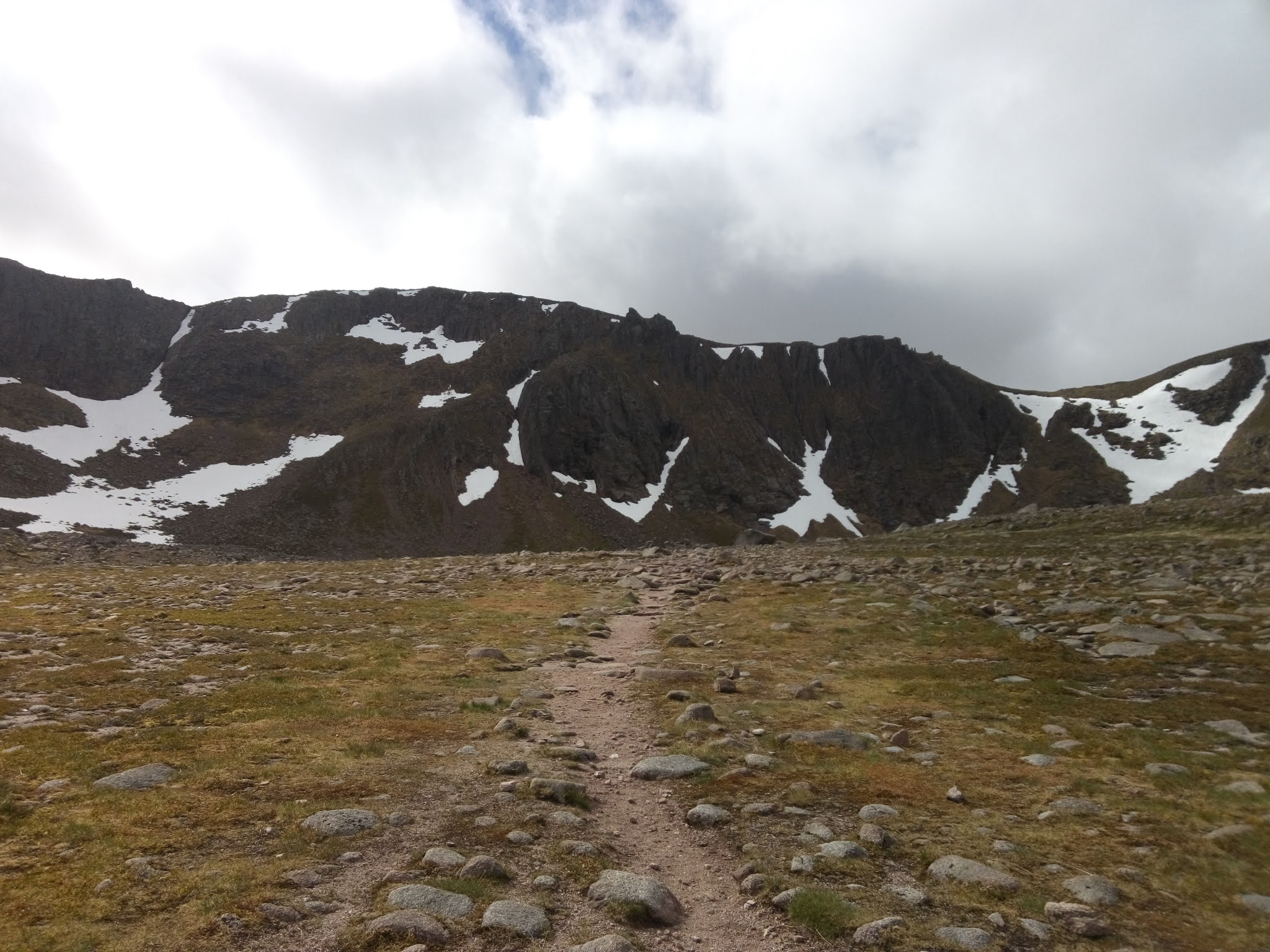
I'm on a recce in the Cairngorms and I've tried to get up on to the plateau near Coire an t-Sneachda, where deep snowdrifts still cling to the walls of the corrie, even in mid June. Out of nowhere, gusts of wind so strong that they twice have me on my knees force me back down.

Having a coffee in the car while assessing alternative routes, I pull a little plastic bag from my backpack, courtesy of a kind friend who doesn't trust me to feed myself, take one of the mysterious, brown wrinkled balls between thumb and forefinger, and savour the sensual springiness as I squeeze. Dipping it in salt crystals from a silver-paper twist, I raise it to my lips and bite. The mouth-feel and flavour are deeply satisfying.

Draining the coffee, I wipe my lips and head up by a different route. Straight out of the car park, I meet a couple of young, street-clothed women pulled along by a perky Jack Russell on a long lead. They ask the way to the Cairngorm summit, so I point them to the Windy Ridge track. But visions of their little pet soaring like a kite, move me to warn of the likely strong gales up top. They thank me kindly, ignore me completely and push on.

My friend Iain reckons no one ever listens to him. That can't be true or I wouldn't know he says it. But I take his point. It's frustrating that you can't pass hard-won experience on to the young. Muttering about this, I find myself joined in my uphill trudge by a tall, dark, similarly muttering figure, with a woolly bunnet pulled down over his forehead and a scarf covering the lower half of his face up to his nose. His beef seems to be tourists rather than young people, but he sounds as disgruntled as me.

Falling silent as he matches his pace to mine with a loping, effortless stride, he fixes me with a disconcerting stare. I feel compelled to speak, so tell him my plan to come back and camp out on Ben Macdui, once I've recced the route.

"Wild camping, iss it?" he says, as he holds me with his glittering eye.

I sense disapproval but burble on. "I've been on a course in the Lake District and now I'm ready to go solo. I'm really looking forward to it. I want to test myself in tough conditions." 

"On Ben Macdui?" he says, shaking his head. "You'll not haff heard of Am Fear Liath Mòr?"

"What's that?"

"It iss a who, not a what. The Big Grey Man of Ben Macdui."

He says no more and a sepulchral silence falls between us, as our footsteps crunch on the stony track, three of mine to two of his, in a syncopated, slightly stressed beat. I'm keen to hear more but hesitant to question him, so I study the plants beside the winding track, many of them more at home in cooler climes than Scotland. 

Dark-hearted flowers of dwarf cornel peek out between clumps of Alpine lady's mantle, their silver-edged leaves spotted with shimmering dewdrops. Ragged deergrass blossoms seek the sun, while solitary bees sip nectar from cloudberry flowers, whose rose-orange fruits I last saw nestling in tall glasses in a Turku boardroom. 

"Strange tales are told of Liath Mòr," my companion comes to life again. "Many more will never be told." He lapses into silence and I wonder if one lifetime will be enough to reach the end of this conversation. 

"Sightings are rare," he starts up again, casting a glance in my direction. "But his presence is often felt and his footsteps heard in the mist ... behind you."

I suppress a shudder and try scepticism. "Yeah, but you get stories like that in the hills. Most told by tourists with scant experience of wind and mist and mountains."

My companion emits a guttural sound and I realise I've annoyed him. "Professor John Norman Collie wass not a tourist," he says. "He was an eminent scientist and mountaineer, the first to tell of Am Fear Liath Mòr."

Crunch, crunch on the track. This is a man who talks slow but walks deceptively fast, and I'm starting to pant as I struggle to keep pace, keen to hear his story. 

“Collie heard footsteps stalking him, near the cloud-covered summit of the Ben. He told himself it was nonsense but the footsteps kept on coming. He was seized with terror. 'I took to my heels,’ he reported later, ‘staggering blindly among the boulders for four or five miles. There is something very queer about the top of Ben Macdui and I will not go back there again.’"

My companion turns his head to gauge my reaction. We walk on. Crunch, crunch, crunch. He speaks again. “Alexander Tewnion was not a tourist. He wass a naturalist and mountaineer. Will I tell you his story?”

By this time I can breathe or speak but not both, so I simply nod and he continues. "As Tewnion reached the top of Ben Macdui, the mist swirled across the Lairig Ghru, shrouding the mountain. He heard loud footsteps and a huge shape came charging at him. He pulled his revolver and fired three times.

“'When it still came on, I turned and hared down the path,’ he reported later, ‘reaching Glen Derry in a time that I have never bettered.’”

Crunch, crunch, crunch. I've heard more than enough to know I should find another mountain for my next camping expedtion. The wind is up again, as strong as ever, shrieking like a lost soul and trying to push me back down the mountain. 

"What about you?" I ask and my companion's dark eyes turn towards me. "Have you ever encountered the Big Grey Man?" 

The cloud is down now, clammy on our faces, as we approach the snow-banks in the headwall of Coire Cas. "I haff not," he says, lengthening his stride and pulling effortlessly away from me. 

As the cloud closes around him his soft Highland tones sound in my ears one last time.

"But you have.”

Sunday, 30 May 2021

Hello darkness my old friend (wild camping part 2)

It turns out Paul and I have a lot in common. He plays the drums. I play the drums. He's a vegetarian. I'm a vegetarian. He's good-looking and knowledgeable. I'm  ...

So anyway. Having ascended every peak in this part of the Lake District, and scaled most of the rock faces, Paul has picked out what he considers an ideal spot for my first night wild camping.

It's not exactly a spot, though, more a vast expanse of marsh and meandering river, cradled by craggy mountaintops. "It's called Great Moss," Paul tells me, as he plots a path across, after three hours hiking. I had pictured something more secluded for my first night under the stars. But Paul knows what he's doing. 

"You'll see the sun rise in the morning over those hills behind us," he says, as we splash across the shallow water. Rejecting several sites as too hard or squelchy he chooses one for me, beside a mountain stream, and another fifty yards away for himself, and we pull the tents from our rucksacks. 

Having learned all I know about tents from Carry on Camping, I expect erecting them to be tricky and time-consuming. But it happens so fast I almost miss it, colour coding and structural ribs made of sectioned tent-poles making it look so easy that I think even an idiot could do it. Fortunately.  

"And there you are," Paul says. "A two-person tent ready for the night."

"How many persons?" I check.

"Two," He confirms. "This one's quite roomy." 

Not to my eyes it isn't. But that's fine. Solo camping is the long-term plan, not snuggling up with a friend – partly because I want to experience the Cairngorm wilderness without distraction, as Nan Shepherd did, and partly because I don't have any friends willing to snuggle up with me on a mountaintop. (Yeah, I asked.)

During dinner, heated on the stoves and saucepans we carried in with us, Paul chats about wild camping around the country. The short version is that, barring a few exceptions, it's legal anywhere in Scotland and nowhere in England*. 

After dinner, we wash our dishes in the mountain stream and Paul gets to his feet, eyeing the track behind us that leads to the peaks. "Do you feel up to it?" he asks. "It'll be easier now you've stowed your rucksack." True enough, I do have a pleasant floaty feeling, but I'm also wearier than I'd normally be after a six mile uphill hike, the after-effects of my second Covid vaccination yesterday. 

It seems a shame not to try for the top, although it's not my main aim in being here, so we set off upwards. But short of the highest point in England, I have to call it a day and we turn back down, to prepare for the night.

The sun is sinking fast now, the warm afternoon yielding to a cool and peaceful gloaming. The air is still, as it has been all day, the only sound the soft splash of the stream we're camped beside, a soothing murmur that should help me sleep. Paul and I chat about the outdoor life as the light leeches away, before he wishes me goodnight and heads for his tent.

So here we are. The moment that's almost haunted my thoughts for over a year. For the next ten hours it's just me, the sky above, the earth beneath and the darkness.

Oh and the thick socks, long pants, thermal vest, woolly bunnet and four-seasons sleeping bag. The forecast is hard frost and I've come prepared. But after an hour I realise I'm not cold. I'm hot. The woolly bunnet stays on, partly because the air is already chilly as the day's heat radiates up through a cloudless sky, but mainly because it's a present from my son.

Not my son the artist, who often appears in these pages. This is another son you've never heard of. My firstborn. We were close when he was a boy. We made each other laugh. But he had a hard time as a young adult and found it easier to cut himself off from us.

Around three years ago he gradually began to come back into my life. We meet regularly now and go long walks together. He's a lovely man. The whole experience, lasting twenty years, has taught me something I didn't know about human biology. You can function at some level with a hole in your heart. But you get to live again when it heals.

The hat stays on, as does the watch he gave me that also shows temperature and compass direction. The socks come off, and the pants and vest. So now I'm stretched out nice and cosy, naked from the forehead down.

Cosy but by no means comfortable. I favoured quality for the rucksack and sleeping-bag, but economy for the mat, a mistake that's borne painfully in on me as the Lake District presses hard on my ribs and hip. I'm convinced sleep is impossible but I'm wrong. 

At around 5 am, when it's - 6 ° C outside, I'm awoken by urgent messages from my nether regions that my arse is freezing off, as are my feet. I pull on socks and pants again and next thing I know it's 7am and I've almost missed the daybreak.

Quickly unzipping the sleeping-bag and tent, I pull on trousers and top and step into a cool morning under a rosy sky, as dawn turns to sunrise and the first rays illuminate the mountaintops, then travel down towards us. It's too good an opportunity to miss, so before packing up, I sit down to meditate, with my back to a rock, facing the sunrise.

Half an hour later, leaving nothing behind us, Paul and I set off, with the sun still warming our way. On the hike down, the chat ranges widely. We compare old injuries, as men do when they're getting to know each other – fractures, sprains, slipped discs, broken hearts. Paul wins the first. I've got him beat on all the rest.

I ask if he considers Ringo a good drummer and nod agreement when he tells me he didn't, but having listened to the thoughts of other great drummers, he does now. He asks if I believe in reincarnation and nods agreement when I say I don't know and it doesn't matter: the principle's the same however you get there – don't harm any living thing.

On the last leg, we again pass the little black lambs who, I 'm guessing, look much better for their night of wild camping than I do. At the cars, Paul and I unload our backpacks and prepare to part. 

I have warm memories of our day and a half together. If I want advice or instruction on any other outdoor activity, he's the man I'll call. We bump elbows, say goodbye and drive off in opposite directions. 

Next stop Ben Macdui in the snow.


Find Paul at Rock n Ridge

* Longer version of wild camping law.

Tuesday, 11 May 2021

Wild camping

My companion raises
an eyebrow but says nothing, as another manly moan escapes my aching body. Soft words and sympathy are not part of Paul's job on this trip. 

Taking me up to the Scafell range, pushing me on if he has to, and showing me how to survive overnight in what promises to be seriously sub-zero temperatures, despite the fact that the sun this morning is blazing down from a big blue sky ... are. 

Having grown up in the Ayrshire countryside, not far from Glen Afton, I'd done lots of running and walking in the hills, over the years, without feeling the need for outdoor activity lessons. Seemed like asking someone to teach me how to breathe. But having reached the ripe old age of none-of-your-business without ever camping in the wild, I got a craving to try it last year while reading Nan Shepherd's 'The Living Mountain'. I wanted to experience a dawn like she describes, in which "I hardly breathe - I am an image in a ball of glass.”

I also wanted to push myself a little, scare myself a bit, without doing anything as stupid as detaching my retinas by diving head-first off a cliff with an elastic band round my ankles. I'd tried Go Ape in the Trossachs, with a friend, which isn't scary but is exhilarating, especially the initial 400 metre zip-wire over a wooded valley. I'd gone coasteering, which allowed us to pose in figure-hugging wetsuits and jump off cliffs into the sea. 

But feeling enough fear to push past, I've found, gets more difficult as the years tick away and emotional scar tissue hardens into the imprint of experience. Just one source of terror from earlier times might, I suspect, still be in there, biding its time to turn my palms wet and my legs wobbly. The scent of tobacco smoke can still carry me back to black nights with the wind howling, when my Dad would come upstairs and lie beside me, his strong presence soothing my fears and helping me drift off to sleep. 

Yep, as a wee boy I was scared of the dark. Imagination conjured monsters from the night. So spending one inside a small tent up a mountain, when you can't see but can hear what's sneaking up on you, may well trigger some of that atavistic dread. Good. That's what I'm looking for. 

The expedition gets off to a shaky start, however, when I don't find Paul until an hour later than we'd agreed, by which time I'm feeling agitated, having misread the map, parked in the wrong place and got to wondering if I'm going to balls up my keenly anticipated but long Covid-delayed expedition before it starts. 

When we eventually do meet up, exactly where Paul said he'd be, I am reassured by his soft Yorkshire accent and air of calm competence, as he shows me how to insert the tent, stove and saucepan he's brought for me into a rucksack I thought was already packed as tight as six badgers in a biscuit tin. 

That done we head off into upper Eskdale, past a pair of tiny black lambs whose large eyes and plaintive bleats make us both go a little soppy. I think I'm going to like this guy. But I'm already beginning to hate my backpack. Paul is moving light and easy, while I trudge along behind, trying to get the hang of walking with a small, knobbly horse on my back. 

It's a gorgeous morning, the Esk below us sparkling white as it rushes over rocks, and translucent green where deep, inviting pools collect the icy waters from the mountains. We pause briefly beside one of these, for a cup of tea and a chat about the other activities Paul offers.

Besides wild camping, these include navigation, abseiling, rock climbing, via ferrata, canoeing, winter skills and a host of others, including ghyll scrambling. 

"You've heard of canyoning," Paul explains. "Well ghyll scrambling is similar except you go upstream instead of down. It's a lot of fun."

"Do you have to carry a rucksack?" I ask.

"No," he tells me.

"I'm in."


(To be continued.) 

Find Paul at RocknRidge 

Tuesday, 18 February 2020

Let me count the ways

The sign on the toilet wall in Nuclear Medicine warns me, for the sake of other users, to aim accurately and avoid the toilet seat, "since your urine is now radioactive".

Well, that's a new one. Little did I realise, as a fresh-faced physics student, learning that an excited nucleus decays by emitting high-energy particles, that one day I'd be pissing them.

"What's your superpower, Douglas?"

"I can shoot gamma rays out my penis."

"Respect, man."

Another sign advises me to avoid "young children and pregnant ladies" for a couple of days, until I no longer glow in the dark or set off smoke-alarms.

All this because I'm having a bone scan to see if the cancerous cells that migrated long since from my prostate have found a new home and started raising a family. But I almost didn't make the appointment. As I was leaving the house, I got a call from a young member of my own family.

"Hi, how you doing?" His usual preamble to bad news.

"Headed to the hospital. You OK?"

"Yeah. Well. Kind of."

"What's up?" I ask, with a sinking feeling.

"Well I was driving to college this morning and the sun started rising in the east, ahead of me. The world changed from black and white to beautiful colour - like the 1960s, I guess, for you hippies. 

"It glowed like the dawn of the last day. Trees on the horizon stood stark and black against a sky that ...

"I get it. It looked nice."

"Nice? This was a symphony in the sky. It was a Shakespearean sonnet of a sunrise. It ..."

"I'm late for a hospital test. Could we get to the action?"

"I've locked my keys in my car."

"Oh dear."

"With the engine running." 

"Bugger."

"And I'm thinking you must have done it yourself." 

Well of course I have. 

"So have you any helpful suggestions?"

"Not really," I tell him. "I did it in my drive. Car key, house keys, engine running. What I did was shinny up the ivy, force open a window and search every nook and cranny in my house, for the spare keys I knew were in there."

"Can't do that," he says. "I'm in a layby out in the country. What's a cranny?"

"Little crack, I think. What are you going to do?"

"Phone Linda and get her out with the spare key. But I'm an hour away. She won't be happy." 

Silence stretches between us. "You'll survive," I tell him confidently.

"Course I will," he says in the same tone.

And he did, I heard later. But when I told the story to a friend, her comment annoyed me initially. "What a Blane thing to do," she said.

On reflection, though, she was right. Locking your keys in your car is hard. But my son did it and I've done it. Another close member of the family went one better. 

She locked herself in her car - don't ask me how - and had to be rescued by the man next door.

It's some kind of genetic thing, I think, travelling down from my Dad's side of the family. My Mum's were all switched on, wide awake, super-alert. Dad was dopey. Two of his sisters were dopier still. My cousins, their kids, were so lightly attached to reality you felt they'd wandered in from a nearby dimension, and were searching for the door back out again. 

They used to make me smile. But self-awareness grew as time passed. I'm just as dopey and I think I've figured out why. I once met Howard Gardner at an educational event in Glasgow. He was affable and persuasive, so I read a fair bit about his Multiple Intelligences theory. 

IQ tests measure only two intelligences, Gardner says - linguistic and logical/mathematical. Quite a number of others exist, including spatial, emotional, interpersonal, kinaesthetic and so on.

High IQ runs in our family so people think we're smart, for a while. Then they realise something Gardner never mentioned. If multiple intelligences exist then so too must something else - which sadly we've got.

Multiple stupidities.

Tuesday, 17 December 2019

Be afraid


Funny thing, fear. I thought I knew what it felt like. An emotion so essentially human shouldn't, after decades on Earth, come as a surprise. But it did to me.

Having had a couple of days to ponder what happened, I believe I've been mistaking fright for fear.

I once came off a Scottish mountain by an unfamiliar route, enticed by a virgin snowfield spread beneath me, sparkling in the low winter sun. Having negotiated the steepest part of the descent, I took my hood off, so I could sense the isolation, hear the stillness and feel the cold from the snow that stretched away from me, as far as I could see. 

Instead what I heard was an echoing sound of rushing water from somewhere below my feet. I realised that I'd wandered onto a snow-bridge high across a stream in serious spate. My stomach lurched. I pictured falling twenty or thirty feet into a raging torrent, gasping for air and being seized and tossed by the flood, with no way out of the darkness, until I breathed no more. 

Gingerly I stepped backwards, following my own footsteps, until the sound of angry water faded, then turned and walked briskly away, my boots crunching in the fallen snow. There's no denying I got a fright. But I don't think what I felt was fear. It happened too fast.

Fear, I've discovered, needs time to build, as you slowly grasp what is about to happen. It also needs uncertainty. If you can take a fast decision and act on it, fright fades before becoming fear. 

Let me share with you how I learned what real fear feels like. 

It's late at night in Killearn and the wind that's been blowing from the west all day has dropped to less than a whisper. The skeletal, leafless trees outside my house are dead still now. A small glass of Dalwhinnie and a mince pie have served as a nice nightcap and I'm anticipating the delicious sensation when I slip between the sheets and every nerve-end in my body basks in the heat from the electric blanket. The intense pleasure often puts me to sleep in seconds.

Tonight, though, I want to read a few more pages of a Peter May novel. May has a knack of writing small details of place and weather that convince you it's fact you're reading and not fiction. Cast Iron is the last in a series featuring his forensics expert, Enzo McLeod, and although it grips and I want to know the ending, I'm thinking that's enough murder mysteries for a while. 

I expect you know this, but the thing about murder mysteries is that somebody always gets murdered. Read too many and you see serial killers around every corner. 

A young woman's body is being lifted from a lake as I start drifting off to sleep. I put the book down, turn the light off and lie quietly in the darkness. There is no sound anywhere in the world that I can hear. And then ...

Two loud knocks on my bedroom door,

I am fully awake instantly. My mind races. Did I dream it? I don't think so. Was it the wind? There is no wind. Can it be one of my sons, both of whom have keys to my house? No, because they don't knock; they open the front door and call out. Is it mice, a few of which have recently got in from my garden? 

I'm clutching at straws and I know it. Only humans knock on doors. I've had a bad fright and I don't know why, or what to do about it. I'm uncertain and confused. Fear starts to build.

I realise I'm going to have to get up, go to the door and open it. My best hope now is that I dreamt it. But as I'm pulling on my trousers the loud double knock comes again. 

I scrabble with both hands at the top of the bedside table and take three steps towards the door. Fear has reached a peak. Fright plus uncertainty plus the almost certain knowledge that something bad is about to happen.

I look down to see what I've grabbed to defend myself. A small hair-dryer and a ventolin inhaler. If my midnight caller has wet hair and a wheeze, I'm in a strong negotiating position.

I open the door quickly, fully expecting to be confronted by a large male, intent on who knows what. 

There is no one there. Moving fast, I search every room in the house. Nothing. As I return slowly to the bedroom, I hear the loud double knock again and this time locate it more precisely. It's not my bedroom door. It's the loft, immediately above the door.

I search the loft with a torch. Nothing.

Eventually I give up and go back to bed. Sleep proves elusive as I try to figure out what could so convincingly simulate a man knocking on my bedroom door. 

Days later, I still don't have an answer. If anyone does, please let me know. I welcome any sensible suggestions. I did an internet search, of course, and the answer came back clearly. 

Racoons.

I don't think it's racoons.

Sunday, 15 December 2019

You can keep it

Well that's enough real life for now, thanks. You can't say I haven't given it a fair shake. 

I've been doing practically nothing but real life since I got the diagnosis five years ago. That's long enough to have formed a solid opinion based on hard facts. 

I once asked a friend what he thought about a TV programme from the distant past called Muffin the Mule:

"Tried it," he replied. "Didnae like it."

Well that's pretty much my verdict on real life. I might check back in five years, to see if the psychos, liars and bastards are still running our country, as well their own. But right now I'm going to focus on friends, family and writing, all of which raise my spirits, while current affairs have, for years, been dragging them down. 

There is a small problem, though, with having writing as your occupation and main method of relaxing. 

Critics excuse me while I spit.

Even my talented friend Gregor, who used to write a light-hearted fortnightly newspaper column, got the occasional bad review. I loved his stuff. So did almost everyone else. But you can't please all your readers. 

One serious-minded soul wrote to the paper, describing one of Gregor's offerings as "worthless and uninteresting small talk." Now despite his rugged looks and firm, well-muscled thighs, honed by cycling to a hardness that makes you  ... ahem, sorry. Despite all that, Gregor is a sensitive soul and he cried on my shoulder.

But only for a brief moment. Writers inhabit a world unknown to normal people, a world filled with rejection. The phrase you hear most often is "Not for me". I once got a rejection letter from some young punk straight out of journalism school who said he "aimed to discourage tired jokes and hoary old clichés".

Eventually though, if you persist, you find a few editors who like your clichés, offer kind words of encouragement and even pay you real money once a month. But to get there you have to turn a blind ear to countless critics, and maybe possess the kind of mentality that makes someone run straight at a bull.

So having been forged in the fires of rejection, Gregor soon wiped away his tears and doubled down on his trademark style of taking a lateral look at life and drawing lessons from the quirkier aspects he finds there. He wrote an entertaining piece on how he did his ironing, which his critic described as "ridiculous and juvenile" and the rest of us really enjoyed.

And isn't this, dear friends, a lesson to us all in these dark December days, made so much bleaker and more depressing by the prospect of five more years of Tory theft, hatred, ignorance and stupidity?

Don't let people talk you into giving up or changing what you know is right. Look after friends, family and anyone less fortunate than yourself. These bad times will pass. 

Scientific studies have shown that the vast majority of us are decent human beings, genetically predisposed to care for each other. The cruel, the greedy and the selfish are in the minority. They are running things now but they won't be forever. If nothing else, climate change might drown the fuckers when the Thames bursts its banks.

And if all that science can't cheer you up, take a look at Muffin the Mule, with his good friend Annette Mills. 

Why don't we sing along with Annette and see if the little chap will come out for us?

We want Muffin, Muffin the Mule,
Dear old Muffin, playing the fool,
We want Muffin, everybody sing,
We want Muffin the Mule.

Tuesday, 30 October 2018

Backwards and in high heels

Jocelyn Bell, just after she discovered the pulsars
I'm sure you've noticed there are far fewer women than men on any list of famous scientists through the ages.  

There's a reason for this imbalance. Female brains are not up to the job. Science is too hard for them, especially physics, the hardest science of all. 

At least that's the story a senior male physicist presented to a roomful of young researchers, mostly female, during a conference at CERN recently on gender issues and high energy physics.

Not surprisingly his presentation went down like the Titanic. CERN promptly disowned it and suspended Prof Strumia "from any activity at CERN", pending an investigation.

Now I'm not and never have been a woman, contrary to what my friend Al says. Not in this life anyway. As a Buddhist, I probably was in a past life and will be again, which is nice. So instead of applying my currently male brain to the issue I decide to consult my friend Ann, who besides being a woman is also a physicist and a feminist. 

I have no doubt she can give me the facts and the female perspective.

But I have to admit to a slight problem with Ann. Tall, confident and clever, she scares and attracts me in equal measure. Which means when I chat to her my savoir-faire sometimes crumbles, like a gluten-free roll.

I once made the mistake of telling her she reminded me of an Amazon. "You think I sell books and don't pay tax?" she said, with a frown that pushed my panic button.

"Strong, scary warrior-women, enemies of ancient Greece, thought to be a myth but some evidence that they existed, I only meant ..."

She pats me gently on the back, cracking a couple of ribs. "Stop burbling," she says. "I know what Amazons are. Why did you want to talk to me about female brains? Are you struggling to understand them again?"

"Not me," I say, leading the way to the table in the corner of the Burnbrae, where Al and I usually take lunch after a session at the gym. "This Italian prof who claims there's loads of evidence that it's men who are discriminated against in science careers - and in life generally - and not women." 

"I saw that," she says, studying the menu. "What do you recommend?"

So we order veggie breakfast and coffee for two from the young waitress who, convinced by our constant bickering that Al and I are an ageing gay couple, studies Ann with surreptitious interest.

"Are you going to take notes?" she asks me. 

"If you don't mind. Means I can quote you accurately."

"No problem," she says, popping a mushroom in her mouth. "Let's start with the reaction from CERN and the audience of young scientists. To me it looks incredibly ineffectual. 

"This guy trots out graphs and charts and quotes scientific papers that he claims supports the idea that women are under-represented at the top of the physics tree, because their brains aren't up to climbing it, and what does CERN do?"

"Apologises for any offence caused," I say. "Then removes his presentation from its website."

"Exactly," Ann says. "They stick their fingers in their ears and go 'Na na na, can't hear you.' They try to shut down the discussion and sidestep the lorryloads of shit headed their way for hosting this guy in the first place. Does that work? Of course it doesn't. All it does is feed the knuckle-draggers' conviction that they're being lied to. That it's political correctness gone mad. That the 'cultural marxists' that Strumia explicitly blames are covering-up the truth."

I have no idea what a cultural marxist is. Maybe I'll ask her later. Right now I'm more concerned by the vigorous manner with which she's brandishing a vegetarian sausage to punctuate her points. I guess no one's ever died of vegetarian sausage wounds, but I don't want to be the first.

Moving my chair back six inches I put the key question to her. "So what is the scientific truth about female brains?"

"I'm glad you asked me," she says. "Here is what we know."

To be continued.